/Marketing/LOGO/Horizontal%20Logo/Color/SMARTGYRO%20H_LOGO%20RGB.png?width=525&height=128&name=SMARTGYRO%20H_LOGO%20RGB.png "logo")

.jpg?width=300&name=Header%20Desktop%20-%20Smartgyro%20gyro%20stabilizer%20vacuum%20sealed%20sphere%20and%20integrated%20pump%20(1).jpg)
In a gyroscopic stabilizer, what happens inside the sphere makes all the difference.
The way air is managed within the enclosure directly influences thermal behavior, mechanical resistance, energy consumption and long-term reliability. At Smartgyro, this internal environment is engineered to balance high performance with durability and real-world serviceability, especially in harsh marine conditions.
Why Vacuum Technology Makes a Difference
To generate stabilizing torque, the flywheel must rotate at an extremely high speed. The higher the speed, the greater the stabilizing force. When air remains inside the sphere, aerodynamic drag increases resistance, heat generation and energy demand.
By reducing or removing air and creating a vacuum environment, resistance is significantly minimized. The flywheel spins more efficiently, requiring less electrical power to maintain speed.
The result:
- Higher achievable speeds
- Greater torque output
- Reduced electrical power consumption
- Cooler motor operation
.png?width=1080&height=566&name=Smartgyro%20Vacuum%20System%20compared%20to%20other%20gyro%20stabilizers%20systems%20(Seakeeper%3B%20Quick%20mc2).png)
Operating in vacuum conditions also protects internal components such as the bearing pack. Without oxygen and moisture inside the enclosure, the risks of oxidation and corrosion are significantly reduced — a crucial advantage onboard vessels exposed to humid, salty environments.
However, not all systems manage this in the same way.
Different Engineering Approaches
The difference between gyroscopic stabilizers lies not only in performance output, but in the way internal resistance is handled and, in the production and maintenance processes involved.
| Smartgyro Vacuum System |
Helium-Based Vacuum Systems |
Non-Vacuum Systems |
|
| Aerodynamic Resistance | Very low (vacuum environment) |
Very low (vacuum environment) |
Present (air at atmosferic pressure) |
| Stabilizing Performance | High torque at high rotational speed | High torque at high rotational speed | Limited by internal air resistance |
| Power Consumption | Low | Low | Higher |
| Thermal Load | Reduced | Reduced | Higher |
| Maintenance Approach | Standard service procedures; no gases or special tools required | Gas-specific procedures required | Standard mechanical servicing |
| Operational Continuity and Long-Term | Vacuum continuously monitored and restored via integrated pump | Relies on sealed vacuum integrity | Not applicable |
Non-vacuum systems operate with air inside the sphere. While mechanically simpler, they inherently face greater aerodynamic resistance, which affects speed, energy consumption and heat generation.
Helium-based systems aim to maximize dynamic efficiency through the use of specialized gas. They can achieve extremely high-performance levels but require sophisticated manufacturing processes and gas-specific maintenance procedures to preserve and restore internal pressure.
Smartgyro’s Vacuum Approach
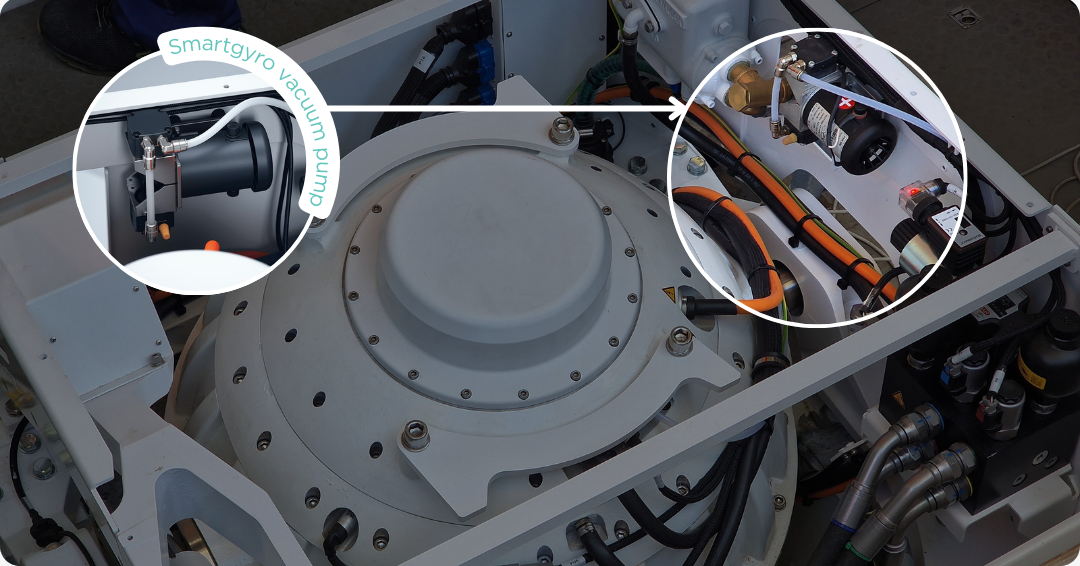
Smartgyro seals the sphere under vacuum using air and integrates an automatic vacuum pump directly into the system.
The gyro continuously monitors pressure inside the sphere, and the pump restores the vacuum level whenever necessary — whether due to minor leakage over time or following service operations.
This architecture delivers the efficiency advantages of vacuum technology while minimizing operational complexity.
Engineering that Serves the Owner
In marine stabilization, peak performance is essential. But long-term reliability, accessibility, and serviceability are equally critical.
By combining vacuum efficiency with an intelligent integrated design, Smartgyro delivers a stabilizer engineered to provide high torque and ensure cost-effective ownership.
True innovation is not only about maximizing performance, it's also about making performance practical.