/Marketing/LOGO/Horizontal%20Logo/Color/SMARTGYRO%20H_LOGO%20RGB.png?width=525&height=128&name=SMARTGYRO%20H_LOGO%20RGB.png "logo")


When it comes to marine stabilization, performance is influenced by more than just size or rotational speed. One of the most important and often overlooked factors influencing stabilizer performance is flywheel orientation.
Whether the flywheel spins on a vertical or horizontal axis directly affects torque delivery, efficiency, and overall roll reduction.
Understanding this difference makes it easier to evaluate how a stabilizer will perform in real-world conditions.
How Orientation Influences Performance
A gyroscopic stabilizer works by spinning a high-mass flywheel at speed and using gyroscopic precession to counteract roll.
The axis of rotation determines how effectively that torque is transferred to the hull. In simple terms, orientation defines stabilizer behaviour.
.png?width=1080&height=566&name=Horizontal%20vs%20Vertical%20Axis%20(Smartgyro).png)
Vertical-Axis Gyro Stabilizers
In a vertical axis stabilizer, the precession axis (the gimbals) is oriented transversely (athwartships).
Because the pitch axis of the boat coincides with the precession axis of the gyroscope, pitch motion does not produce a significant dynamic input that forces additional precession. If the boat pitches whilst the flywheel is tilted (due to precession), the resulting gyroscopic torque appears primarily as a yaw moment. This yaw torque is absorbed “statically” by the gimbal bearings and by the longitudinal stringers of the hull, meaning it does not enter or disturb the dynamic roll-control loop.
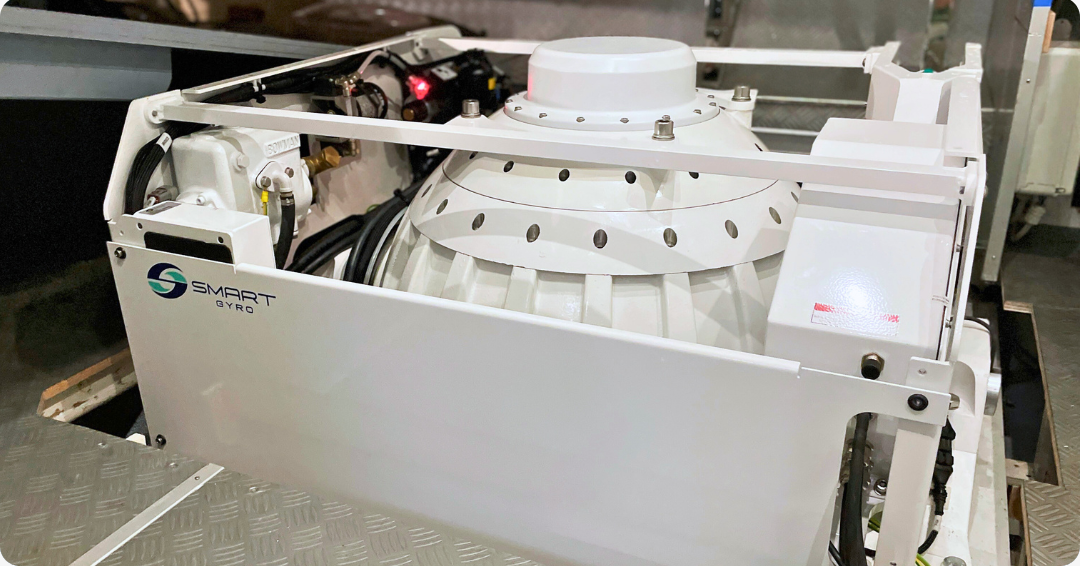
In other words, pitching movements do not affect the precession movements of the sphere, except to a marginal extent. This means that the anti-roll control algorithm is not affected by this “pitching disturbance” and is able to function effectively in all sea states and wave directions (all wave directions other than perfectly abeam have a pitching component).
In addition, vertical axis gyroscopes are designed to have the centre of gravity of the precessing sphere located below the precession axis; this creates an "automatic” restoring torque that helps the sphere to return to the vertical, to a "zero position".
As a result, anti-roll torque is transferred efficiently and predictably to the hull. The result is a stable, consistent roll reduction across varying sea states, wave direction and vessel types.
Horizontal-Axis Gyro Stabilizers
Within these types of stabilizers the flywheel rotates around a horizontal axis and the precession axis is vertical.
With this approach, by distributing the mass along the horizontal axis, the overall dimensions can be reduced, offering some advantages in installations where space constraints are critical.
However, when the flywheel, due to precession, is tilted away from its zero position (defined as its spin axis aligned with the transverse axis of the vessel), it becomes sensitive to pitching. Therefore, any pitch motion generates crossaxis coupling: pitch angular velocity induces additional, unintended precession torque.
This creates “parasitic” effect on the precession movement, driven not only by roll (desired) but also by pitch (undesired). As a result, the gyro is desynchronized with respect to roll and overall roll control is reduced.
Furthermore, horizontal axis stabilizers lack a natural restoring torque and an intrinsic “zero position”; in certain sea states, this can reduce responsiveness and overall antiroll performance compared with a vertical axis design.
Vertical vs Horizontal Axis at a glance
| Vertical Axis | Horizontal Axis | |
| Primary Design Focus | Maximum anti-roll torque in all sea conditions | Compact layout and mechanical simplicity |
| Anti Roll Performance | Consistent and predictable in all sea states | More limited |
| Installation Footprint | Larger overall volume | More compact |
Why Smartgyro Focuses on Vertical Axis Technology
Smartgyro’s commitment to vertical-axis technology reflects a single core objective: delivering the highest possible stabilization efficiency in all conditions.
By focusing on torque optimization, reliability, durability, and intelligent system control, Smartgyro creates solutions that deliver roll reduction that is immediately perceptible on board — whether cruising, anchored, or operating in demanding conditions, completely transforming the onboard experience.
Gyro stabilization is not just about fitting a unit into an engine room. It is about how the vessel behaves once it leaves the dock, and orientation plays a defining role in that performance.